skip to main |
skip to sidebar
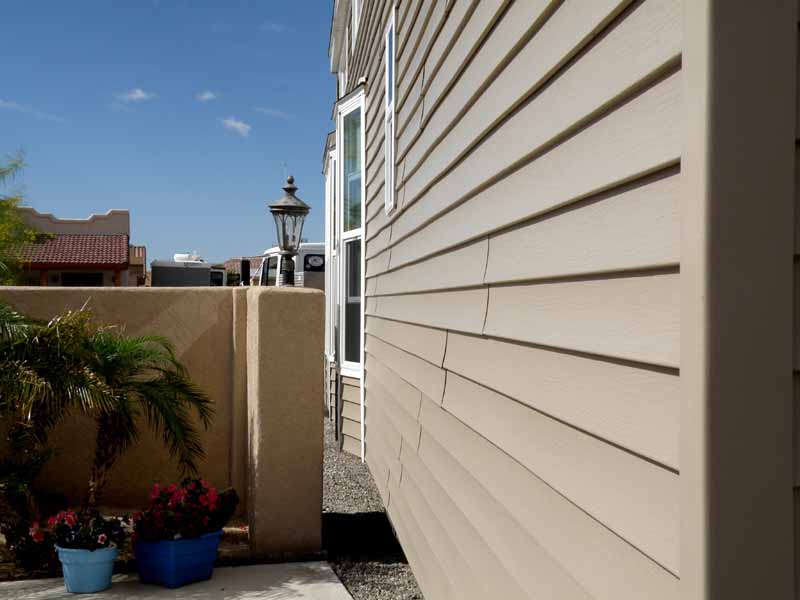
Not entirely content with where the park model was placed Marc thought about switching it to the back of the lot, crosswise. Then we thought about the cost to do new hookups, have a crane swing it into place, and other numerous impediments. I liked where it was for the fact of it facing the street (its best facade), the mountain view out the living room window and front porch, and the fact of directly walking from the patio instead of through gravel. So, we compromised when Marc figured it out that by moving the park model over about three feet encroaching over the patio he would have a wider side yard to park stuff; namely the boat and maybe his work trailer.
First order was to move the park model into the street and out of the way. Our neighbor Ron was there to help all the way. After hitch-up with the Freightliner, with the correct size ball this time, Marc eased out and over the curb cut and into the street. The park model joined the flatbed and the shed trailers on our quiet street.

 Marc then hitched up to the shed trailer backing it into the far back corner of the lot literally right next to the block wall. Since it is a trailer and not a permanent structure, there will be no set back requirements the county can enforce even though it will remain for the future as a storage shed. This way we can get maximum use out of all our lot’s square footage.

 Like the ace driver he is, Marc rehitched the Freightliner to the park model and even without mirrors wide enough to see around its girth, he backed that baby in like a pro in one shot. Whew, it was close though. With no room to maneuver he had to leave it canted and then he and Ron got busy hand-winching it over about four feet which took over an hour of jacking and winching. They carefully measured to get the front aligned with the back end, allowing for about ten feet so we can fit the boat alongside. Great job guys! There is still much to be done, but figuring out the structure of the lot is done. Next up: we get an “oh no, what will the neighbors say” red sea container!
Marc has the brilliant idea that we need to find a cut bank or wash so he can unload the storage shed from the flatbed. When he first loaded the shed onto the flatbed in Bend he did it the same way only then the shed was empty of contents and he used a cut bank. The only thing we find close by in our neighborhood is a wash; sand and all, and a little steeper than what I would have considered “safe”. You can see where this is going can’t you? For some reason he feels he needs my help and asks me to go along and “it shouldn’t take more than an hour.”
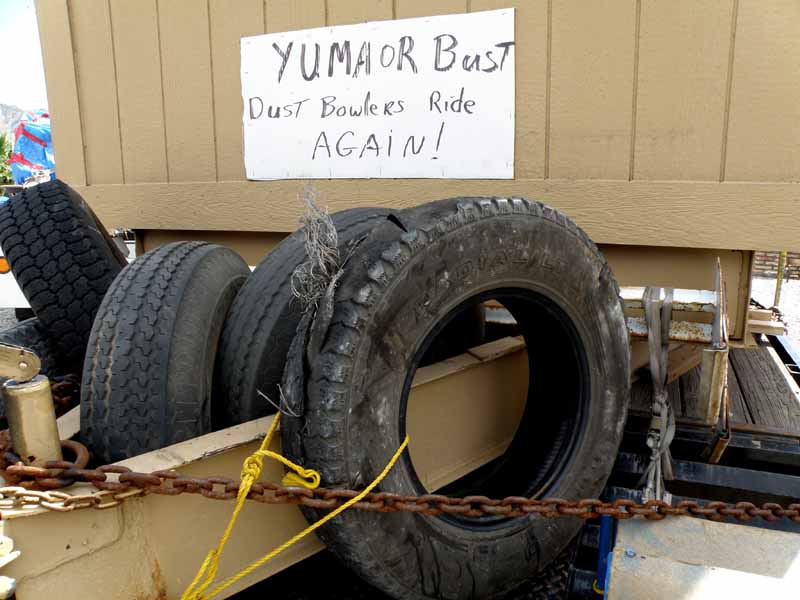
We get the truck and trailer situated in the wash and he starts the task of putting all the tires back on the shed axles. This alone takes well more than an hour, while I stand in the broiling sun just occasionally lending a hand to something. First one side, then the other, gets jacked up and tires mounted. Since he left the correct ball back in Bend, he has the wrong size ball for the hitch which causes problems from the get-go and will further complicate things as the task progresses.


 Finally, he’s ready to pull the shed off the flatbed and he starts ever so slowly. Things go great until suddenly everything starts to slide, including the shed pulling the flatbed trailer along with it about a good four to five feet. The ramps crumple off the end of the trailer and everything comes to a screeching halt with my shouts “Stop, stop, stop!” Now what?


 Apparently a small portion of frame steel had hung up on the flatbed lumber deck, ripping it, and causing everything to grind to an immediate halt. Marc jacks up that portion of the trailer that is hung up and places a piece of plywood as a skid plate under it; hitches up, and tries again. With gut-wrenching scraping and loud clangs, the shed breaks free and crashes down off the platform tearing off all the rear trailer lights.

 I wish I could say this episode from hell ended there, but unfortunately, it didn’t. There was yet the wash for the shed to traverse back across and then Marc needed to get it to the lot, drop it and return for the flatbed. Once he reached the wash with the shed, it jumped the hitch not once, not twice, but three times until he finally just chained it to the Freightliner hitch and drug it far enough into a leverage point so it would weigh the hitch enough coming out the other side so as to not jump off yet again.


 The unexpected slide the flatbed had done put it well below optimum level for the Freightliner to get hitched back to it since it was now sunk dismally in the belly of the wash. Thankfully, our neighbor Ron, worried we had been gone so long--now into a three hour ordeal; came out looking for us to see if we had problems. He helped Marc jack up the stabilizer foot high enough Marc could sneak the Freightliner into place for hitch-up but not before another mishap where it fell off the jack and ripped through the Rhino bed liner on the back of the Freightliner. Another trailer returned to our lot and the task is finally over with as I note I am covered in sunburn from the unexpectedly long exposure. What a day!
 As a child I used to run barefoot on clover lawns and to this day can remember the many painful bee stings I would endure as the honeybees worked the tiny flowers for pollen. Legend has it that the more you are stung, the more allergic your reaction to bee stings becomes. I believe it, because now when I suffer a sting, the affected part or extremity swells up badly—really badly, for weeks. The last time I was stung I was riding my motorcycle through Yellowstone and can remember a bug hitting my cheek and instant and excruciating pain. I got Marc’s attention and we pulled over; I fought the helmet quickly off my head, the bee flew out and Marc noted that my cheek was already starting to swell. By the time we got back to our campground hours later, the entire side of my face was two sizes too big.
A little while ago there was a report about two Phoenix women out walking in the evening in a city neighborhood when they were attacked by a swarm of bees. They ended up hospitalized and the experts are saying this could be a bad year for bee swarms in southern Arizona. To make matters worse, some have been Africanized. All around us now, the desert blooms full of yellow and red color. I wanted pictures but I don’t like to tempt fate needlessly so for the most part I have been staying away from solitary desert excursions.


 Even the Ocotillos have taken on brilliant colors, fully fleshed out with their miniature green leaves, a sight rarely seen most of the year.

 Then there is our orphan volunteer tree; we think it’s a Mexican Palo Verde. Its seed must have been dropped out of a bird one day to just start growing. Its pinnate leaves are much smaller, growing on longer feathery stems, than those I find elsewhere around here, domestic or wild. It also doesn’t flower nearly so much although the small flowers show amazingly intricate detail. That works to save the bees to buzz around other trees, in other neighborhoods and yards, which is just fine with me.